
From Closure to Alternative Corridors: How Iraqi–Syrian Trade Reconfigured Its Routes after 8 December 2024
Introduction
Since 8 December 2024, trade relations between Iraq and Syria can no longer be read as an ordinary cross-border exchange file. Rather, they have become a direct test of both countries’ ability to reactivate their economic geography under the pressure of security considerations, political transformations, and market demand for stable outlets. On that day, overland trade between the two countries entered a phase of acute disruption with the closure of the Al-Qaim border crossing, which had been one of the main corridors for the movement of passengers and goods between Iraq and Syria.
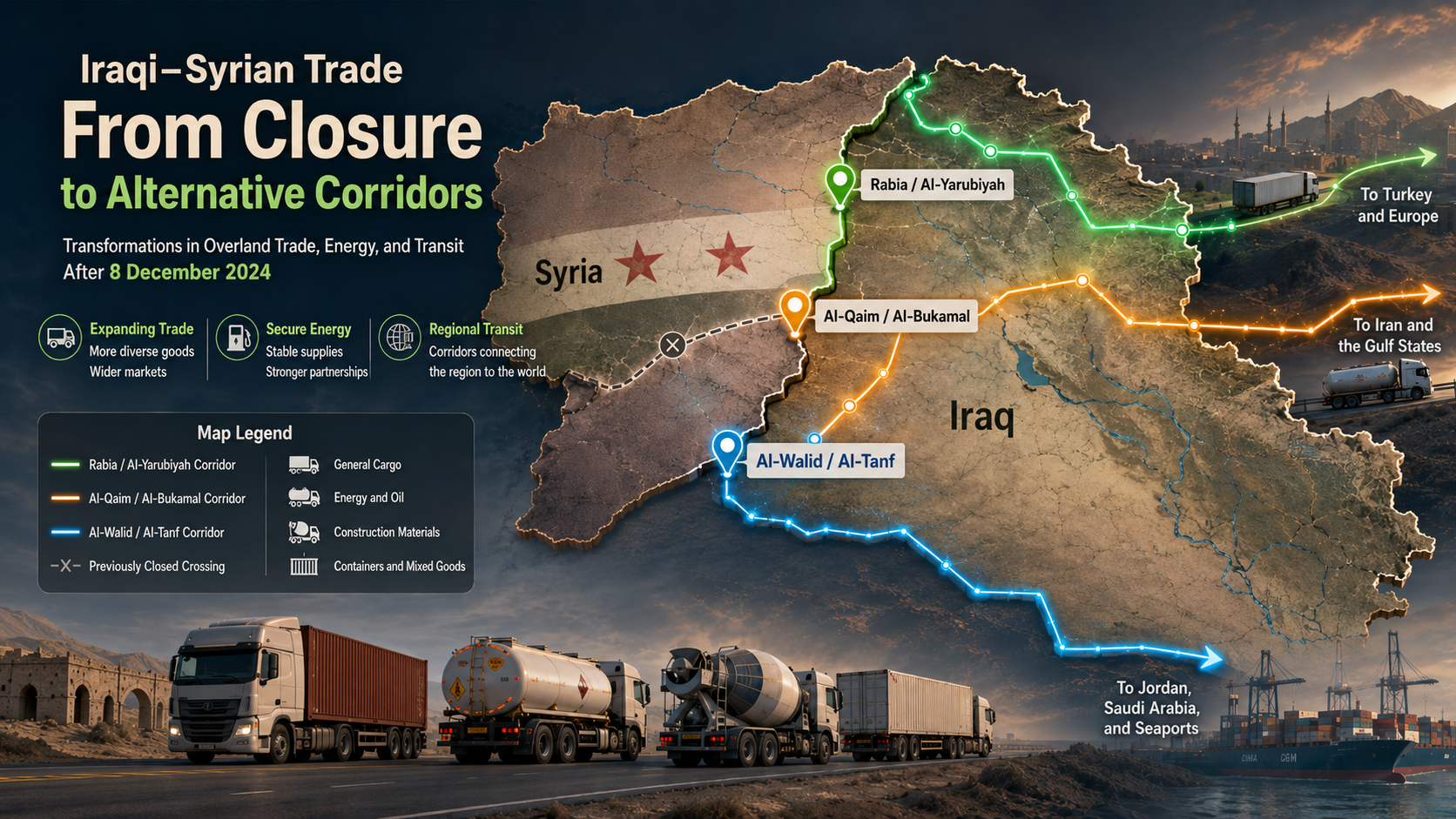
What followed, however, was not an automatic return to the pre-closure situation. Instead, it was a gradual process that began with suspension, moved through political and security negotiations, and then led to the reopening of Al-Qaim/Al-Bukamal, before expanding in 2026 into a broader network of crossings through Al-Walid/Al-Tanf and Rabia/Al-Yarubiyah. As a result, the trade relationship shifted from reliance on a single crossing to a logic of diversified routes, and from limited bilateral trade movement to broader roles encompassing energy, cement, general goods, and regional transit.
First: 8 December 2024 — The Moment of Trade Disruption
The most significant shift in Iraqi–Syrian trade relations began with the closure of the Al-Qaim border crossing by the Iraqi side following the fall of Bashar al-Assad’s regime. This closure was not a mere administrative detail; it effectively severed one of the most important arteries of movement between the two countries. Al-Qaim, which connects on the Syrian side with the Al-Bukamal area, is not only a passenger crossing but also a route for goods and commercial exchange between western Iraq and eastern Syria.
At that moment, security considerations prevailed over commercial calculations. The Iraqi–Syrian border was being managed according to a sensitive equation: preventing any security breach, controlling border movement, and awaiting clarity regarding the situation on the Syrian side. As a result, direct commercial activity through this axis declined into a state of near-total paralysis, while the economic file remained dependent on security and political assessments.
Second: From Suspension to Testing Political Will
During the first months of 2025, trade between Iraq and Syria was not in a phase of growth, but rather in a phase of searching for the conditions necessary for its return. The most prominent political signal in this process came on 14 March 2025, when Syrian Foreign Minister Asaad al-Shaibani visited Baghdad and called for reopening the borders, linking this step to the strengthening of trade between the two countries.
That visit showed that the resumption of exchange was not a purely economic decision, but rather a file intertwined with security, diplomacy, and commerce. Iraq did not treat the border merely as a passage for goods, while Syria was seeking to restore economic connectivity with its neighborhood. This phase can therefore be described as a period of “political and security preparation” preceding the actual return of trade exchange.
Third: 14 June 2025 — Al-Qaim/Al-Bukamal Returns to Operation
On 14 June 2025, trade relations entered a new phase with the reopening of the Al-Qaim/Al-Bukamal crossing to trade and passengers. The announcement that the first Syrian truck had entered after inspection procedures was not merely a border-related news item; it was a practical signal that the main overland channel between the two countries had returned to service.
The importance of this return lies in the fact that it ended the phase of direct disruption. However, it did not mean that the relationship immediately returned to its previous levels. Published sources referred to the resumption of movement and the return of passengers and trucks, but they did not provide a unified official figure for the value of trade exchange after the reopening. Accordingly, the most accurate description of this phase is “controlled resumption,” not a “trade boom,” because the available facts confirm operation but are insufficient to establish a comprehensive financial volume.
Later, published data in the second half of 2025 confirmed the continued economic and passenger movement through Al-Qaim, while the Iraqi Embassy in Damascus denied reports that the crossing had been closed. This confirmation is significant because it shows that the reopening was neither symbolic nor temporary, but had turned into regular operation under border controls.
Fourth: 2026 — From a Single Crossing to a Network of Crossings
The year 2026 witnessed the clearest transformation in trade relations between Iraq and Syria. Instead of confining the relationship to Al-Qaim/Al-Bukamal, Baghdad and Damascus moved toward expanding the border infrastructure through two additional crossings: Al-Walid/Al-Tanf and Rabia/Al-Yarubiyah.
In February 2026, the Iraqi directive to expedite the opening of the Al-Walid and Rabia crossings with Syria emerged as a key development, with the aim of raising the level of trade exchange and benefiting from logistical connectivity. This direction gave the relationship a new practical dimension: the objective was no longer merely to reactivate a closed crossing, but to build a wider movement network capable of accommodating goods, tankers, transit trucks, and passenger movement.
The opening of the Al-Walid crossing in April 2026 represented a pivotal step in this direction. The inauguration coincided with the entry of Iraqi tankers loaded with fuel oil heading toward Syria, placing the energy sector at the heart of the new trade relationship. This was followed by the opening of Rabia/Al-Yarubiyah on 20 April 2026, adding another corridor of economic, political, and security importance, especially amid official statements about its use for the exchange of goods and commodities, the export of oil, and as a route for Turkish goods crossing Syrian territory.
Here, the nature of the relationship changed: Syria was no longer merely a neighboring market for Iraq, and Iraq was no longer merely an eastern land outlet for Syria. The shared border became part of a broader logistical architecture connected to energy, goods movement, and cross-border transit.
Fifth: Energy and Cement — Commodities Documented by the Facts
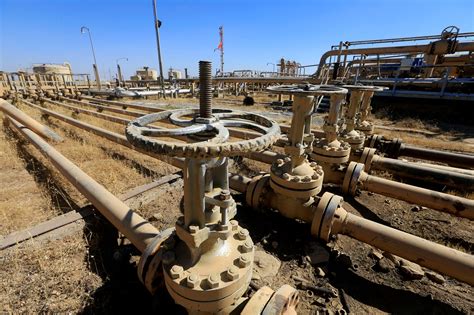
One of the most notable features of 2026 was that published facts did not merely refer generally to “trade exchange,” but identified specific commodities. The start of crude oil exports through the Rabia crossing toward Syria was announced, while data also referred to the entry of fuel oil tankers through the Al-Walid/Al-Tanf crossing. In addition, the Iraqi Border Ports Authority announced the launch of the first shipment of Iraqi cement exports to Syria through the Al-Walid crossing.
These facts are important because they show that exchange did not remain limited to consumer goods or general truck movement. Rather, it entered sectors of direct economic weight: energy and construction materials. Moreover, the use of crossings to transport oil and fuel links the trade relationship between the two countries to regional supply chains, not merely to local border movement.
Sixth: The Return of Syrian Goods and Regional Transit
In 2026, movement was not only from Iraq to Syria. The Iraqi General Commission for Customs announced the arrival of the first two commercial trucks from the Syrian side through the Al-Walid crossing, in a step officially presented as an indicator of the resumption of commercial activity through this crossing. The Rabia crossing also witnessed the passage of a batch of transit trucks coming from Turkey through Syrian territory toward Iraq.
More importantly, Al-Walid received the first international transit shipment under the TIR system, coming from Syria and heading to Kuwait through the Safwan crossing. This development moves the Iraqi–Syrian relationship from the level of bilateral exchange to that of cross-border corridors. When a shipment passes from Syria to Kuwait through Iraq, border cooperation becomes part of a regional trade network, rather than merely a bilateral file between two neighboring countries.
This becomes even more significant with Iraq’s activation of the TIR system in 2025 and its subsequent use in actual transit shipments. By its nature, the system enhances the organization of overland transit and reduces customs complexities, making the Iraqi–Syrian border more capable of integration into regional transport chains.
Seventh: Health Restrictions and Border Control — Trade Is Not Open Without Conditions
Despite the clear expansion in the opening of crossings, trade movement was not without restrictions. In May 2026, Iraq’s Ministry of Agriculture announced a temporary suspension of the transit entry of live animals from Syria toward Iraq and the Gulf states due to the risks of foot-and-mouth disease and the need to protect livestock resources.
This incident reveals an important aspect of the new trade relationship: border openness does not mean the removal of controls. Rather, trade between Iraq and Syria at this stage is moving within an equation that combines facilitation of transit with inspection, health oversight, customs procedures, and security calculations. This is the essence of the new phase: opening crossings, but under a regulatory framework that prevents openness from turning into disorder.
Eighth: As of 12 June 2026, Syria as Part of Iraq’s Alternative Land Crossings
In the latest indicators published as of 12 June 2026, Syrian crossings appeared within the Iraqi discussion on alternative land outlets and trade flow. Statements attributed to the Iraqi General Commission for Customs referred to the role of land crossings in maintaining the flow of trade, as well as to the establishment of Al-Walid and the activation of Rabia to absorb growing commercial movement.
This point gives Iraqi–Syrian relations an additional dimension: the crossings with Syria are no longer merely a bilateral route, but have become part of Iraq’s ability to manage logistical alternatives when maritime routes or ports come under pressure or disruption. Thus, in Iraq’s declared trade discourse, the Syrian border has become an element of commercial resilience, not merely a neighboring gateway.
Conclusion
From 8 December 2024 to the present, trade relations between Iraq and Syria have passed through three documented moments: disruption, resumption, and logistical expansion. The phase began with the closure of Al-Qaim under the pressure of security concerns, then movement returned through Al-Qaim/Al-Bukamal in June 2025, before 2026 witnessed the opening of Al-Walid and Rabia and the entry of energy, cement, and international transit into the core of the trade relationship.

.jpeg)
.jfif)