
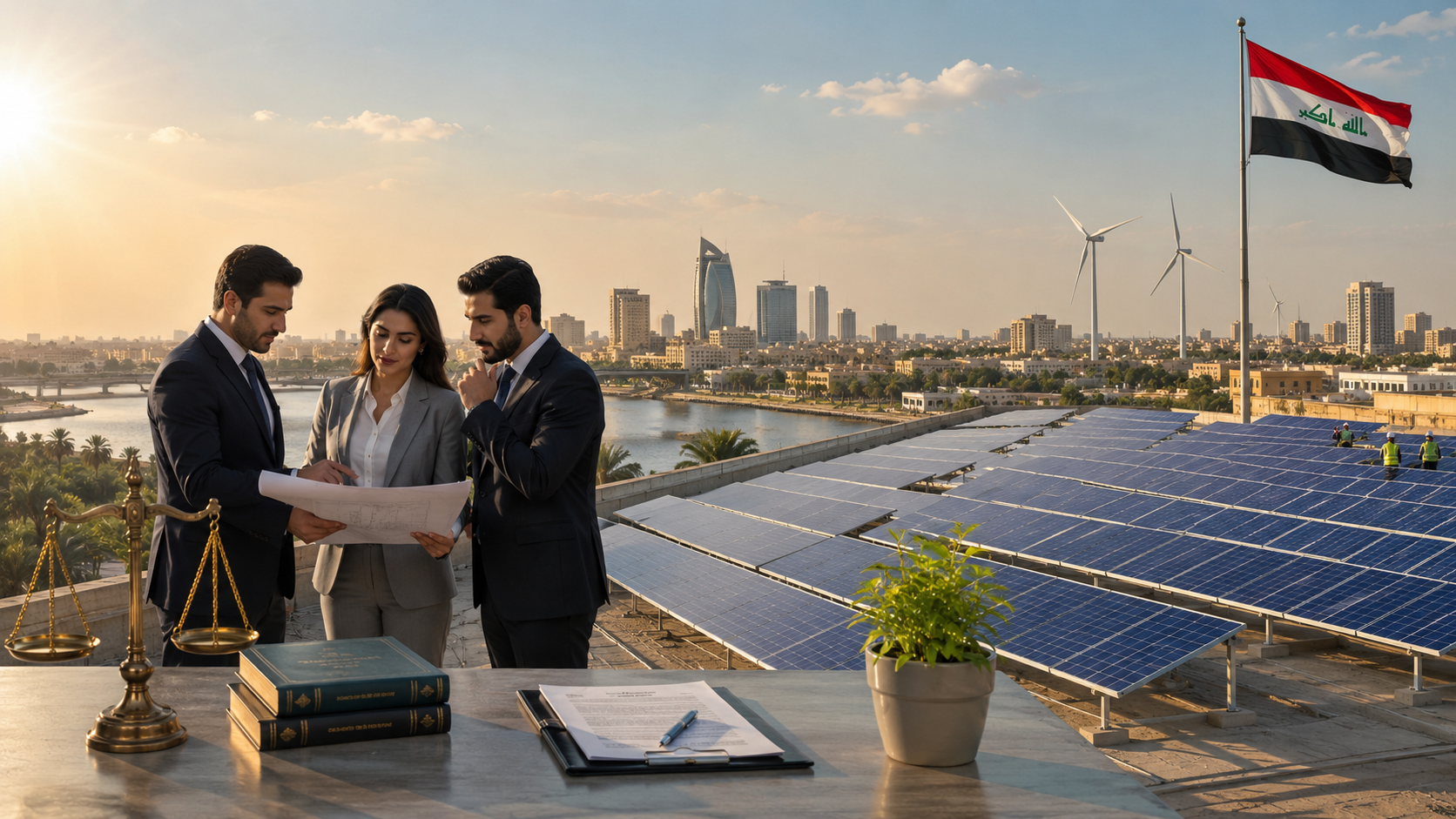
Green Investment and Renewable Energy Technologies in Iraq
An Emerging Legal and Economic Opportunity
Iraq is witnessing a gradual shift toward green investment and renewable energy technologies, driven by the need to address the electricity crisis, reduce dependence on fossil fuels, and respond to international climate obligations. Given Iraq’s substantial solar resources and growing energy demand, renewable energy projects—particularly solar energy—have become among the most promising areas for both domestic and foreign investment. However, the success of these projects does not depend solely on technical feasibility; it is directly linked to the legal, regulatory, and financing framework governing them.
Iraq has a natural environment well suited to the development of solar energy projects, particularly in the southern and western governorates, which enjoy high levels of solar irradiation. The state has begun offering solar energy projects under the Independent Power Producer (IPP) model, in addition to major projects connected to the national grid and initiatives to finance renewable energy systems for individuals as well as commercial, industrial, and agricultural projects. These developments open the door for investors to enter multiple sectors, including solar power plants, rooftop systems, batteries, energy efficiency, load management solutions, and emissions-reduction technologies.
From a legal perspective, green investment in Iraq stands out as a field that requires particular attention in contract drafting and risk management. Renewable energy projects often require power purchase agreements, public-private partnership contracts, government licenses, land allocation, environmental approvals, financing arrangements, and guarantees related to payment and grid connection. Moreover, the absence of a unified and comprehensive legislative framework for renewable energy may create challenges for investors, particularly with respect to tariff stability, arbitration mechanisms, sovereign guarantees, and enforcement procedures.
The importance of legal consultation in this sector is further heightened by the overlap among the relevant authorities, such as the Ministry of Electricity, the National Investment Commission, environmental authorities, banks, local governments, and foreign entities involved in financing or implementation. Accordingly, investors require an integrated legal assessment covering project structuring, regulatory compliance review, financing contract analysis, land-risk assessment, the organization of the rights and obligations of the parties, and the establishment of effective dispute-resolution mechanisms.
Green financing also represents an important opportunity to expand investment in Iraq, whether through bank loans, investment partnerships, international financing, or future instruments such as green bonds and climate funds. However, benefiting from these instruments requires the preparation of precise legal documentation, compliance studies, and contractual guarantees suited to the nature of long-term projects.
Green investment and renewable energy technologies in Iraq constitute a promising sector that brings together national energy needs, economic opportunities, and environmental obligations. Although the market remains in its formative stage, significant opportunities are available to investors who approach this sector with a clear legal vision and careful risk management. Therefore, the success of renewable energy projects in Iraq requires not only technology and financing, but also a strong legal structure that ensures investment protection, guarantees compliance, and achieves long-term sustainability.
.jpeg)
.jfif)