
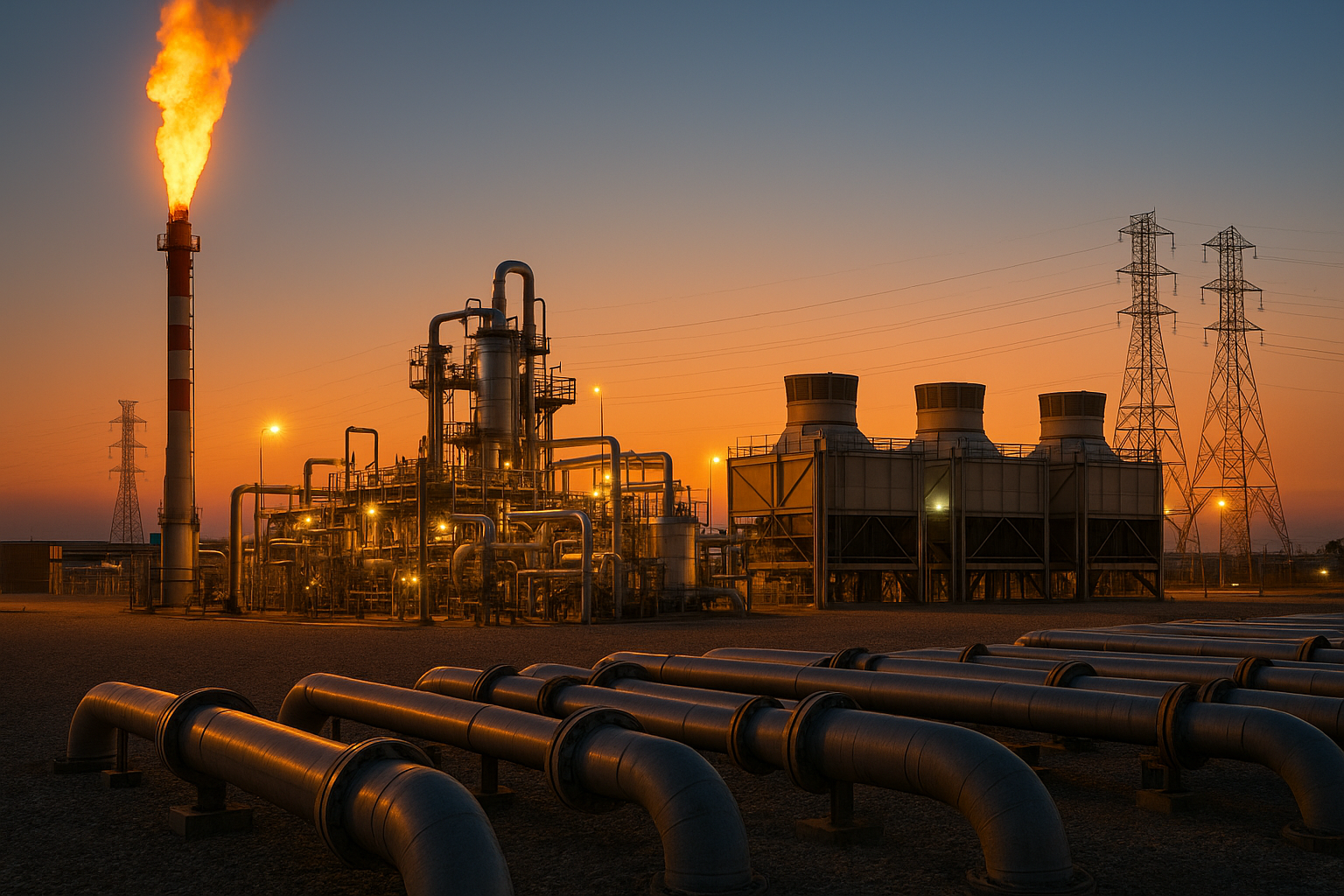
Iraq’s Energy System at a Critical Crossroads
Iraq’s energy landscape stands at a decisive turning point between continuing to waste associated gas through flaring or transforming it into a driver of electricity generation and industrial growth. Throughout 2024–2025, the federal government placed associated-gas utilization, power generation projects, and complementary energy solutions at the center of the governmental program. Repeated statements from the Prime Minister’s Office, the Ministry of Oil, and the Ministry of Electricity emphasized accelerating implementation, integrating sectoral efforts, and advancing a major investment track known as the Integrated South Project / Gas Growth Integrated Project (GGIP).
The GGIP: Core Components and Current Progress
According to the Ministry of Oil, the GGIP is built on four primary pillars:
-
Development of the Artawi oilfield,
-
Capture and processing of associated gas from multiple southern fields for use in power generation,
-
Construction of a large-scale seawater treatment facility to supply southern fields with injection water, and
-
A 1,000 MW solar power component in Basra.
By April and June 2025, the Ministry confirmed notable progress, stating that the Artawi oilfield is expected to reach a production capacity of 210,000 barrels/day upon completion. The seawater treatment project remains an integral part of the package, and associated-gas investment projects continue to be treated as a national priority. Earlier, in December 2024, the Ministry announced a “fast-track project” in agreement with the partner company to capture 50 million standard cubic feet per day (MMSCFD) of associated gas by the end of 2025—aimed at powering local electricity plants and reducing summer shortages by relying on domestic gas instead of flaring.
Government Decisions and Execution Milestones
In 2025, the Prime Minister’s Office published several decisions signaling a shift from contracting to defined implementation packages:
-
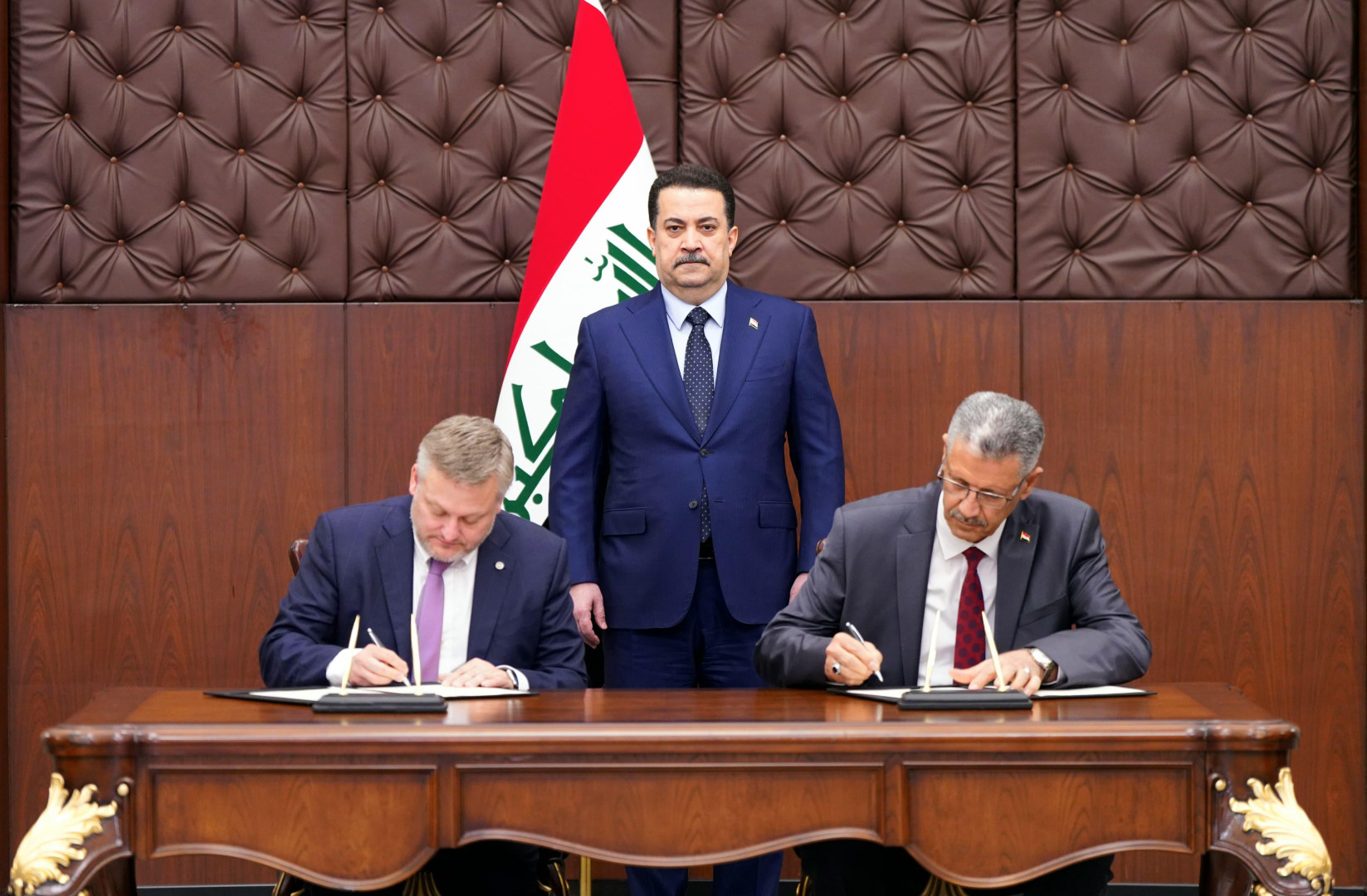
Signing of the Shared Seawater Treatment Facility (STF) contract with the foreign partner and industrial contractor, with a design capacity of 7.5 million barrels/day—an essential project for sustaining southern oilfield production and easing technical constraints related to injection.
-
Confirmation of tariff and development cost structures for the 1,000 MW Artawi solar power plant, intended to mitigate peak demand and reduce reliance on liquid fuels.
-
Official statements reaffirming that the TotalEnergies project remains under execution within the service and development program.
These measures provide investors with regulatory and temporal clarity regarding implementation progress, pricing approvals, and grid-connection frameworks.
Electricity Sector Integration and Gas Utilization
In parallel, the Ministry of Electricity has pursued a complementary track to reduce losses and enhance gas-based generation. In August 2024, it documented direct cooperation with the Ministry of Oil to advance associated-gas utilization nationwide. The Ministry also announced an agreement with Siemens to convert flared gas into usable fuel within short timelines, thereby boosting generation capacity and lowering reliance on inefficient alternatives.
When aligned with the GGIP, these operational steps create a functional bridge between gas production and processing on one side and the power grid’s ability to convert that fuel into stable electricity output on the other.
Policy, Regulatory, and Carbon Economics
Ministry of Oil data released in 2025 demonstrates that associated-gas investment has transitioned from isolated projects to a broader portfolio of policies and instruments—including preparations for carbon-credit mechanisms—to strengthen economic and environmental feasibility. Notably, official communications now emphasize execution and progress over declarations of intent, marking an important shift for investor confidence.
Multiple gas-investment projects currently under development are positioned as core components of Iraq’s long-term energy security strategy, reducing outages and increasing reliance on domestic fuel.
Legal Framework for Investors: Investment Law No. 13 of 2006
Investors in this sector operate under Iraq’s Investment Law No. 13 of 2006, as amended—a framework that defines incentives, guarantees, investment authority procedures, ownership rules, and tax treatment. On 16 June 2025, the Ministry of Justice re-published the law with its latest amendments and official translations, ensuring accessibility to the most up-to-date version. Full Arabic texts are also available through official government portals and provincial investment commissions.
This documentation is essential for conducting proper legal due diligence before entering development contracts, especially in strategic sectors such as oil, gas, and electricity.
Economic Risks, Returns, and the Investment Window
From an economic standpoint, government sources indicate that capturing and directing associated gas to power generation can yield substantial foreign-currency savings by reducing imports, generating value from gas that was previously flared, and strengthening the power grid’s ability to withstand summer peaks.
Economic feasibility materializes only when the chain is fully closed:
-
Field development (e.g., Artawi)
-
Gas processing facilities
-
Transmission lines to power stations
-
Supporting infrastructure such as seawater treatment and renewable energy projects
Cabinet decisions and ministerial statements confirm that these links are being completed sequentially through contracts, pricing approvals, and technical development steps. This enhances project bankability and reduces operational uncertainty. Nevertheless, security challenges, procedural complexities, execution capacity, and supply-chain limitations remain real risk factors. Proper partnership models with state-owned companies, especially in the southern oil and gas sector, are necessary to enable early gas output while final facilities are completed.
Conclusion: A Transition from Announcement to Execution
Iraqi official documents from 2024–2025 indicate a clear transition from the “announcement phase” to the “sequential execution phase” in the Integrated South Project and associated-gas investment initiatives. With an updated legal foundation, structured government decisions on pricing and grid integration, and active implementation by the Ministries of Oil and Electricity, Iraq is progressing toward meaningful integration of domestic gas into its power system.
Turning flared gas into local fuel strengthens energy security, reduces waste, and stimulates investment. However, achieving the full economic payoff depends on disciplined timelines, integrated infrastructure, and contractual adherence until design capacities are commissioned. For these reasons, the period 2025–2027 appears to be a critical opportunity window to consolidate this transformation, based on the latest official Iraqi decisions and execution reports.
.jpeg)
.jfif)