
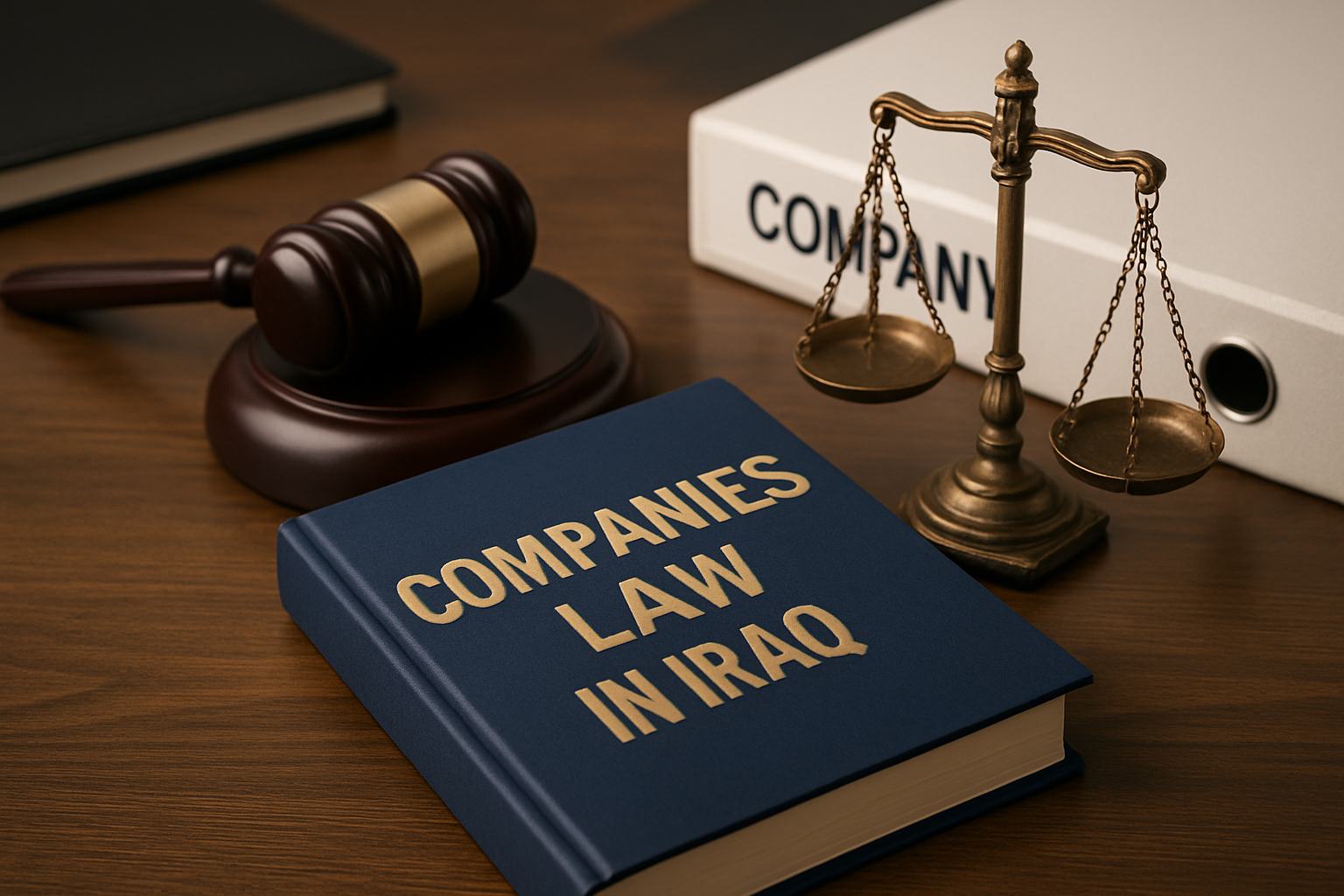
1. Definition of the Law
The Companies Law No. 21 of 1997, as amended by Order No. 64 of 2004, serves as the primary legal framework regulating companies in Iraq. It governs the establishment, types, management, capital structure, supervision, and dissolution of companies. The law applies to private companies, mixed-sector companies, and financial investment entities, and is also applicable to banks, insurance companies, and financial institutions to the extent that it does not conflict with their special legislation.
2. Objectives of the Law
Article (1) outlines four core objectives:
-
Regulating companies in terms of legal form, management, and obligations.
-
Protecting creditors from fraud and from actions that threaten their rights, particularly during near-insolvency or capital withdrawal.
-
Protecting shareholders and equity holders from conflicts of interest or misconduct by the board of directors or controlling shareholders.
-
Enhancing transparency and disclosure by requiring management to provide adequate information regarding decisions that impact shareholder investments.
In essence, the law does more than regulate the corporate form: it establishes a framework of trust and protection in corporate dealings.
3. Philosophy of the Law
The legislator’s philosophy is reflected in three fundamental principles:
Transition to a market economy:
By opening the door to private and mixed companies, regulating financial investment and branches of foreign companies, and reducing centralized planning.
Strengthening governance and transparency:
Through regulating general assemblies, boards of directors, executive managers, auditors, and requiring disclosure of major contracts, conflicting interests, and executive compensation.
Protecting credit and ensuring transactional stability:
By specifying minimum capital requirements, regulating capital increases and reductions, addressing significant losses, and setting precise rules for liquidation and distribution of company assets.
4. Main Sections and General Structure of the Law
The core structure of the law can be summarized as follows:
-
Company Formation and Legal Personality:
Requires a written memorandum of association, capital deposit in a bank, and registration with the Registrar of Companies. Legal personality is acquired upon issuance of the certificate of incorporation. -
Types of Companies:
The law regulates joint-stock companies (private and mixed), limited liability companies, general partnerships, sole proprietorships, and simple companies, outlining partner numbers and liability limits for each. -
Capital, Shares, and Contributions:
Defines minimum capital requirements, division of capital into shares or quotas, acceptance of in-kind contributions, and mechanisms for increasing or reducing capital while safeguarding creditor rights. -
Company Management:
Organizes the general assembly as the supreme authority, sets out rules for boards of directors in joint-stock companies, specifies the powers of the authorized manager, and details procedures for meetings and decision-making. -
Supervision and Inspection:
Defines the roles of the Registrar of Companies, external auditors, and the Federal Board of Supreme Audit (for mixed companies), and prescribes inspection mechanisms when violations occur. -
Mergers, Conversions, and Liquidation:
Establishes rules for merging companies, converting legal forms, conditions and procedures for liquidation, debt settlement hierarchy, asset distribution, and deletion from the register.
5. Conclusion
The Iraqi Companies Law No. 21 of 1997 (as amended in 2004) constitutes the foundation of corporate regulation in Iraq. It strikes a necessary balance between:
-
Freedom to establish companies and attract investment,
-
Protection of creditors and investors, and
-
Governance and oversight mechanisms that ensure transparency and accountability.
Practically speaking, no investor or company operating in Iraq can overlook this law, and no legal professional working in company formation, mergers, or liquidation can dispense with a deep understanding of its structure and provisions.

.jpeg)
.jfif)